
Flannery O'Connor on Insufferable Writers
Can a lazy, arrogant writer with no ideas be redeemed?

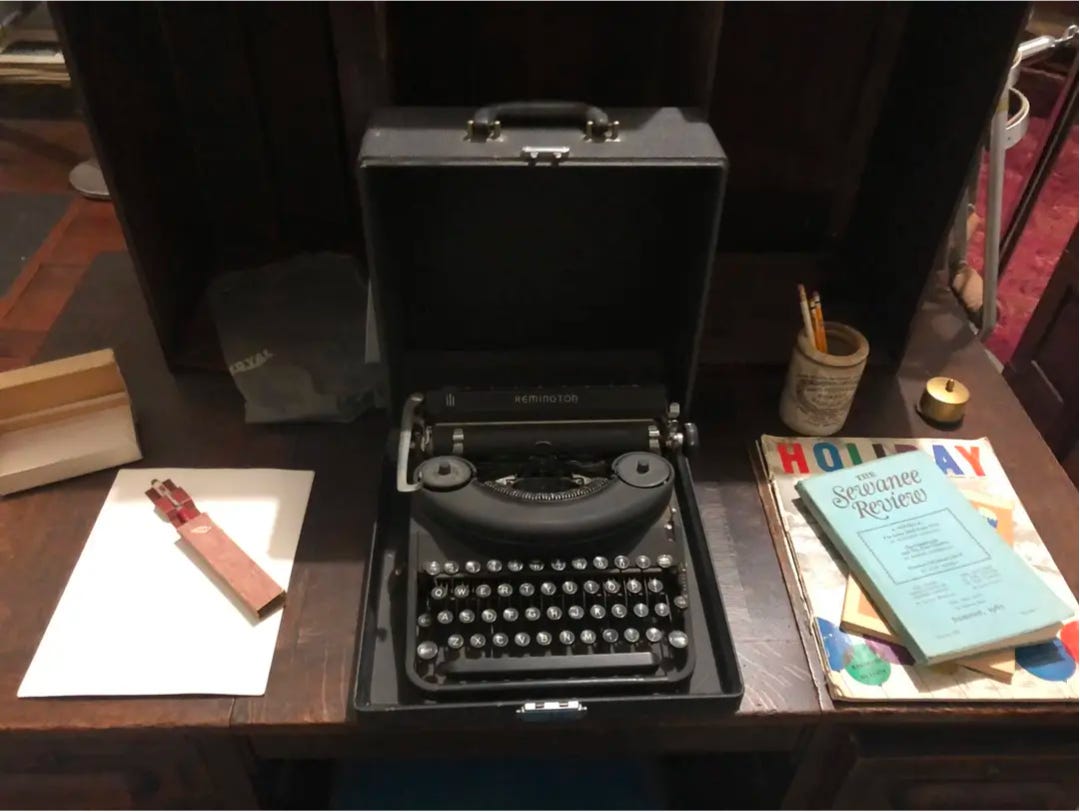
Before turning to ritual as a weapon against Resistance, I want to talk about my favorite Flannery O’Connor story, a precursor to my eventual conversion. In it, the vivid anomalies of her more famous stories are nowhere to be found. There is no murderer on the loose or angry spinster with a wooden leg.
Its main character is that most modern of types: a boomerang child in his twenties who moves back home after failing to gain a foothold in world, to no one’s joy. He holes up in his childhood bedroom, full of self-pity and long-simmering resentments.
In “The Enduring Chill,” first published in 1958, Asbury Fox is 25 years old and has been working part-time at a New York bookstore when he returns to the family farm in rural Timberboro. Suffering from a mysterious illness, he steps off the train “pale and puffy” with a receding hairline, resigned to the “unique tragedy of his death.”
His mother, a practical widow who runs the farm, reflects:
When people think they are smart—even when they are smart—there is nothing anybody else can say to make them see things straight, and with Asbury, the trouble was that in addition to being smart, he had an artistic temperament.
His older sister, a local school principal, welcomes him home:
“What is that cry of deadly pain?” his sister drawled from the back seat. “Oh, it’s you,” she said. “Well well, we have the artist with us again. How utterly utterly.”
His literary output is a touchy subject:
What had he ever published, [his sister] wanted to know, and for that matter, what had he ever written? . . .
Mrs. Fox was not up on things like that but she suggested that he might be writing a very long book. Very long book my eye, Mary George said, he would do well if he came up with so much as a poem. Mrs. Fox hoped it wasn’t going to be just a poem.
At the farmhouse, Asbury hauls himself up to his childhood room, where, above his bed, a leak in the ceiling has made a spot shaped like a “fierce bird” with an icicle in its beak. “It had been there since his childhood and had always irritated him and sometimes frightened him.”
Asbury has, in fact, been writing in New York: He has composed a long accusatory letter to his mother, blaming her for his failure to become an artist. She is to find it after his impending death.
The next words were underscored twice. “I have no imagination. I have no talent. I can’t create. I have nothing but the desire for these things. Why didn’t you kill that too? Woman, why did you pinion me?”
Everything else he’s ever written—two novels, a half-dozen plays, multiple poems and short stories—he’s thrown away, hating it all.
Asbury is actually quite sick. He sends away the folksy local physician—Dr. Block—in a fit of rage and disdain. He sits sullenly on the porch waiting to die, racked with fever, chills, and fatigue. His sister scoffs that “it’s all psychosomatic” and he just needs “two or three shock treatments. Get that artist business out of his head once and for all.”
Mostly to irritate his mother, Asbury asks for a priest. He wants a cultured Jesuit, a fellow intellectual to bandy with before he dies. The local priest who shows up at his bedside, however, is a “massive old man” with a red face, blind in one eye and hard of hearing, who doesn’t even recognize the name James Joyce. He grills Asbury on his moral conduct “in a martial tone” and is dismayed by what he learns.
“Nothing is overcome without prayer. Pray with your family. Do you pray with your family?”
“God forbid,” Asbury murmured. “My mother doesn’t have time to pray and my sister is an atheist,” he shouted.
“A shame!” said the priest. “Then you must pray for them.”
“The artist prays by creating,” Asbury ventured.
“Not enough!” snapped the priest. “If you do not pray daily, you are neglecting your immortal soul. Do you know your catechism?”
“Certainly not,” Asbury muttered.
. . .
“How can the Holy Ghost fill your soul when it’s full of trash?” the priest roared. “The Holy Ghost will not come until you see yourself as you are—a lazy ignorant conceited youth!” he said, pounding his fist on the little bedside table.
Mrs. Fox burst in. “Enough of this!” she cried. “How dare you talk that way to a poor sick boy. You’re upsetting him. You’ll have to go.”
After the priest leaves, Asbury’s symptoms worsen. But, as he plans his final trip to the hospital, Dr. Block pulls up in the driveway. He’s finally solved the puzzle of Asbury’s illness.
For those who haven’t read this story, I don’t want to spoil the twist. Suffice it to say all of Asbury’s problems are self-created. The local elders he thought beneath him—Mrs. Fox, Dr. Block, and Father Finn—helped him out of sheer indefatigable decency. And now, in spite of himself, he’s going to live.
This understanding hits Asbury in one whack, as if a Zen master had smacked with a board. Alone and gazing in the mirror, his eyes “looked shocked clean, as if they had been prepared for some awful vision about to come down on him.”
He “had always relied on himself and never been a sniveler after the ineffable.”
But the bird on the ceiling appears to be moving . . .
If you don’t find Asbury relatable, I don’t know what to tell you. When I first read this story, long ago, I was agog to learn what happened to him. The fierce bird was hovering on my ceiling, too. The rustic people in my town were stupid . . . weren’t they?
He is objectively ridiculous, and yet, O’Connor loves him. Her love and care for him is subtle and exquisite. In 1958, she turned 33, the same age as Asbury’s sister Mary George. But Mary Flannery understood him better. After attending the Iowa Writers’ Workshop and working on a novel at Yaddo, she was diagnosed with lupus, a severe autoimmune disease and, in 1951, moved back to her mother’s farmhouse in Georgia. She was 25 and had been told she had four years to live.
In some sense, Flannery is Asbury. His grandiose self-pity as his body fails him is her shadow side, a darkness in which she could not afford to linger. How easy it would have been, too, to resent her normie mother and the yokels of rural Georgia, people so less stimulating and sophisticated than she deserved!
She did not do this, of course. She did something much more interesting. Bolstered by otherworldly power—6 a.m. morning prayers, daily Mass, three hours of writing before she grew tired, Thomas Aquinas on her bedside table1—she turned the straw of rural Georgia into literary gold for fourteen years. Instead of dwelling on the “unique tragedy” of her death, she had the clear-eyed gratitude to apprehend the unique comedy of her life.
What she knew, Asbury has to learn. The end of the story intimates that he will. In order to be a real writer, he has to learn it.
Importantly, it’s his job to become a writer. His sister’s bitter, close-minded view that he should “get that artist business out of his head once and for all” is simply wrong. He really is unlike his mother and his country lawyer father. He really is unlike Mary George, who promptly settled into a life of least resistance.
Asbury moved to New York, lived in a squalid room, and worked at a bookstore while writing novels, poems, and plays. He has a fanciful, imaginative mind: The water spot over his bed appears to him as a “fierce bird” with “an icicle in its beak and there were smaller icicles depending from its wings and tail.” No other Fox—possibly, no one in Timberboro—would have seen it as anything but a reason to call the plumber. He has a vivid, surreal dream about his burial—a dream which suggests that, subconsciously, he knows why he is sick. Though he can’t decode the signals, his antenna is in the air, attuned to radio transmissions from some other world.
Asbury is a prideful mess, but O’Connor’s tough love for him is a love for artists—for all ink-stained wretches, emphasis on the wretch. She is an older sister showing us the ropes, and a stunning punch of humility is her most loving gift.
Source: Mason Currey, Daily Rituals (Picador 2014).
This essay made me get out of my comfy rocking chair to root around on my shelves for the volume of her complete stories! I admit, I have never read this one! But you have left me INTRIGUED!! Thanks!!